

The short answer
What this setting controls
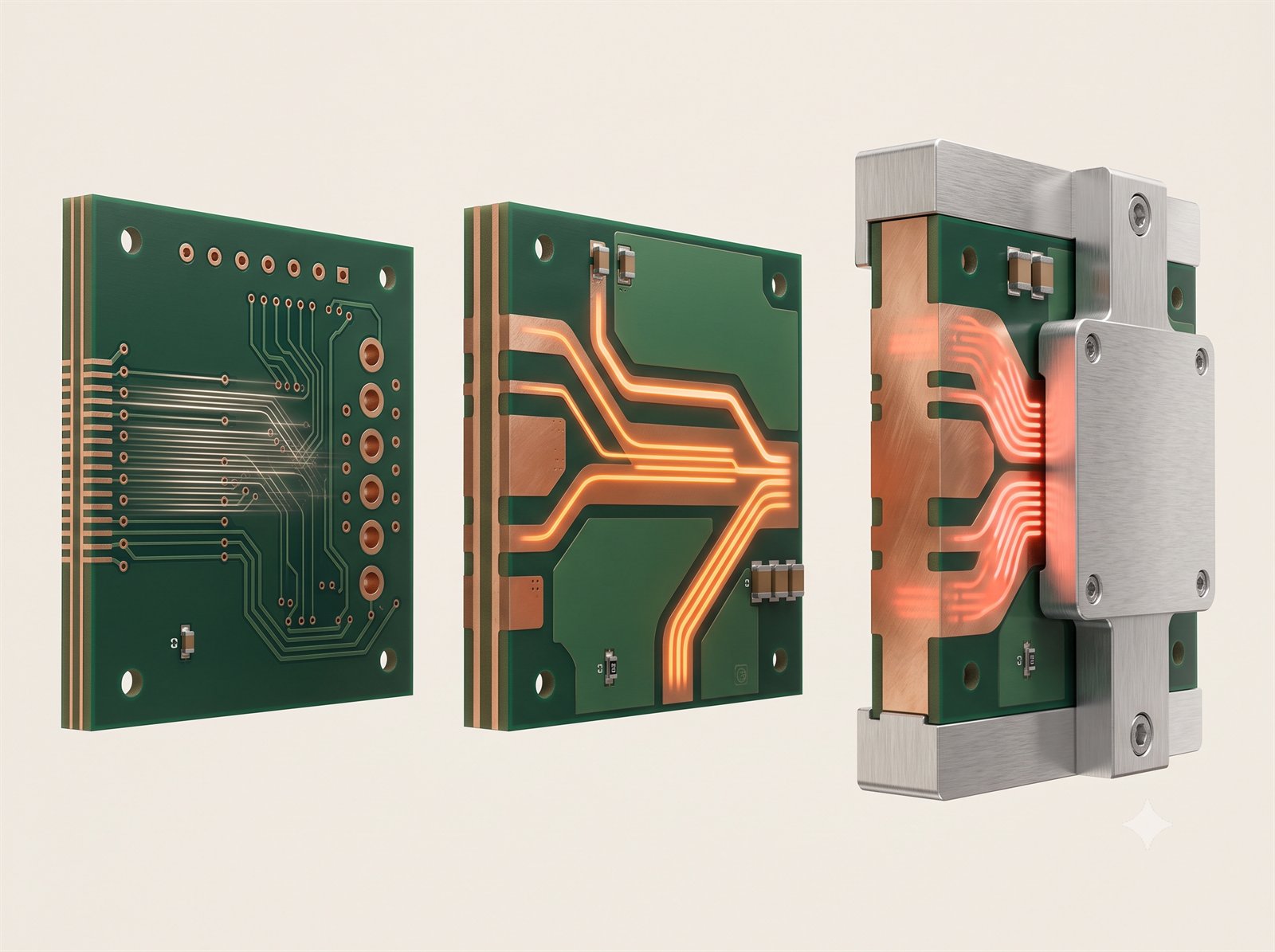
1 oz is a common starting point for ordinary signal and power routing. Higher weights are useful for heavier current or thermal spreading, not as a universal upgrade.
Use the finished copper value with trace-width calculations, via current, thermal rise, etch compensation, impedance and clearance rules. Heavy copper can narrow the available fine-pitch geometry.
Options in the order form
How the available choices differ
| Choice | Use it for | Engineering note |
|---|---|---|
| 1 oz | General signal and modest-power routing | Common starting point; calculate temperature rise for power paths. |
| 2 oz | Higher current or improved heat spreading | Etching compensation can widen minimum trace/space requirements. |
| 2.5 oz and above | Heavy-copper power structures | Requires compatible spacing, via plating, thickness and process capability. |
Compatibility
What can change with this selection
- Layer count and via-plating method can change the available weights.
- The inner copper choice is a separate decision for multilayer boards.
- If the page disables a choice, treat it as a compatibility result and adjust the controlling design decision rather than forcing the value.
Practical recommendation
How to make the decision
- Start at 1 oz unless the current or thermal design calls for more.
- Use the calculator and fabrication drawing to validate heavy-copper traces and vias.
- Recheck thickness, material and via-plating compatibility after changing copper.
Before release
Check these points before adding the quote to cart
- Confirm the selected value matches the released Gerber, drawing, stack-up, BOM or assembly plan.
- Review any fields that changed automatically after this selection.
- Check the board preview and server-calculated estimate before adding the quote to cart.
- Start at 1 oz unless the current or thermal design calls for more.
- Use the calculator and fabrication drawing to validate heavy-copper traces and vias.
- Recheck thickness, material and via-plating compatibility after changing copper.
Frequently asked questions
Answers for ordering and design review
Does 2 oz mean twice the current?
It provides more cross-sectional copper, but allowable current also depends on trace width, temperature rise, airflow and the rest of the design.
Can heavier copper replace a thermal design?
No. Copper thickness is one part of the thermal path. Trace width, length, planes, vias, airflow, interface materials and allowable temperature rise still need calculation.
Why is an option disabled?
The current material, geometry, layer count, quantity or another selected process makes that combination unavailable. Change the controlling selection or revise the design package rather than trying to bypass the disabled state.
Can I rely on the online choice as final manufacturing approval?
No. The interface screens known combinations and requests pricing, while final manufacturability remains subject to the released files and technical review.
What should I record outside the order form?
Put controlled requirements in the fabrication drawing, assembly drawing, stack-up, BOM or acceptance plan. Use Special instructions only for a concise pointer to that controlled requirement.
Will changing this update other selections?
It can. The order form re-evaluates compatibility and may replace a now-invalid dependent choice before requesting a fresh server-side estimate. Review every highlighted or automatically changed field.
What if the design requires an option that is not offered?
Do not approximate it with a different label. Recheck the controlling material and geometry, document the actual requirement, and request technical review before placing the order.
Useful engineering tools
Calculators and preparation guides
Further reading
Standards and technical references
Use the latest applicable revision and your organisation’s controlled requirements when a standard forms part of product acceptance.